


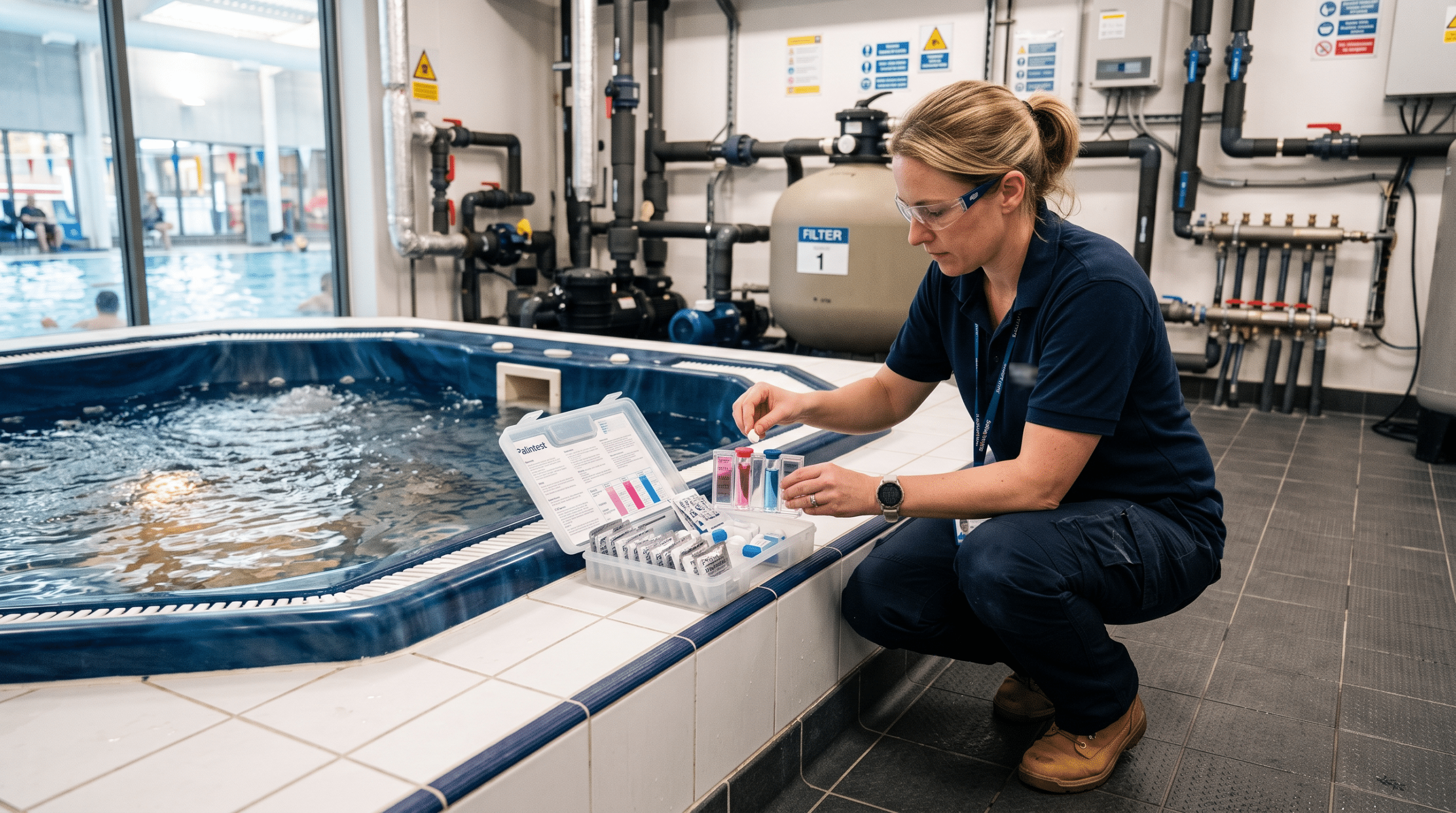
Running a commercial spa or hot tub comes down to three chemical jobs: keep a sanitiser residual in the water at all times, keep the water balanced so the sanitiser can work, and test often enough to prove both. Spa pools run hot, hold a small volume of water and carry a high bather load, which is why they need a stricter routine than a swimming pool, and why the HSE publishes dedicated guidance for spa-pool systems (HSG282). This guide covers what UK operators should stock, the routine that keeps water safe, and how to buy spa chemicals sensibly at trade volume.
Why spas are harder work than pools
A spa concentrates everything. Warm water accelerates chemical reactions and microbial growth, aeration drives off sanitiser faster, and a handful of bathers in a small water volume adds far more organic load per litre than a busy swimming pool. The HSE’s guidance on the control of legionella and other infectious agents in spa-pool systems, HSG282, exists precisely because poorly managed spa pools are a recognised source of infection, including legionnaires’ disease (hse.gov.uk/pubns/books/hsg282.htm).
The practical consequence for operators is a simple one: a spa’s water condition can move in hours, not days, so chemical stock and testing discipline are not optional extras. They are the operation.
The chemical jobs every spa operator covers
Commercial spa chemicals fall into a few functional groups. Whatever the brand on the label, an operator’s shelf needs to cover:
- Sanitisation. Chlorine-based sanitisers are the pool-side standard; many spa and hot tub systems run on bromine instead, which is more stable at spa temperatures. The right choice depends on your system and its commissioning.
- pH control. Sanitisers only work efficiently within the correct pH band, so you need the means to move pH up and down.
- Total alkalinity. A buffer that stops pH swinging every time bathers get in.
- Water clarity. Flocculants deal with the fine particles that filtration alone misses.
- Descaling and cleaning. Heat plus hard water means scale on heat exchangers, tiles and filters; periodic cleaning protects the plant.
- Testing. Test tablets or an equivalent method for sanitiser level and pH, used several times a day in a commercial setting, with results logged.
Easy Chemicals Trade stocks trade quantities across these groups, from spa products to the wider commercial pool chemicals range that pool-and-spa sites draw from.
Water balancing: the part that makes everything else work
Water balancing means keeping pH, alkalinity and hardness inside their working ranges so the sanitiser stays effective and the plant is protected. Unbalanced water shows up fast in a spa: sanitiser that disappears as quickly as you add it, cloudy water, bather complaints about skin and eye irritation, and scale or corrosion in the plant room.
The operating principles are the same everywhere, and they are deliberately unexciting:
- Test before opening, then at intervals through the operating day, and log every reading.
- Dose according to the product label and your test results, never by habit or guesswork.
- Add chemicals to water as directed on the product, never mix products together, and store them in their original containers, segregated and secure.
- Re-test after dosing and before bathers return.
Dosing quantities are system-specific: always follow the instructions on the product you are using and the guidance from your test kit or water treatment adviser. If in doubt, HSG282 and your pre-commissioning documentation are the reference points.
Buying spa chemicals at trade volume
Small leisure-retail packs are the expensive way to run a commercial spa. Buying spa chemicals in trade pack sizes cuts the unit cost and the reorder frequency, but two habits keep bulk buying safe. First, match pack size to turnover: sanitisers degrade over time, so buy what you will use while it is fresh rather than the largest drum on the page. Second, read the safety data sheet before you order. Every product’s SDS should feed your COSHH assessment, and a good supplier makes the datasheet available from the product page; see the supplier’s safety information for how documentation is provided.
Frequently Asked Questions
What chemicals do I need for a commercial spa or hot tub?
As a minimum: a sanitiser suited to your system (chlorine or bromine based), pH adjusters up and down, an alkalinity buffer, a clarifier or flocculant, a descaler for periodic plant cleaning, and reliable test supplies with a logbook.
Are hot tub chemicals different from swimming pool chemicals?
They overlap, but spas run hotter with a smaller water volume, so bromine-based sanitisation is common and dosing routines are more frequent. Several core products, such as pH and alkalinity adjusters, serve both.
How often should spa water be tested?
In a commercial setting, several times a day, with results logged. HSG282, the HSE’s guidance for spa-pool systems, sets out monitoring and management expectations for operators.
Can I buy spa chemicals in bulk in the UK?
Yes. Trade suppliers sell spa and pool chemicals in trade pack sizes, from poly containers to drums. Buy to your actual turnover so sanitisers are used while fresh.
Why does my spa’s sanitiser level keep dropping?
Heat, aeration and bather load all consume sanitiser quickly in a spa, and unbalanced pH makes it less effective. Check and correct the water balance first, then review bather load and your dosing routine.
Spa water care is a routine, not a rescue: cover the six chemical jobs, balance the water, test relentlessly and log everything, with HSG282 as the compliance backdrop. Operators who buy their spa chemicals at trade volume, matched to real turnover, run cleaner water at lower cost. Easy Chemicals Trade supplies spa and commercial pool chemicals to leisure operators across the UK, with documentation available before you buy.