


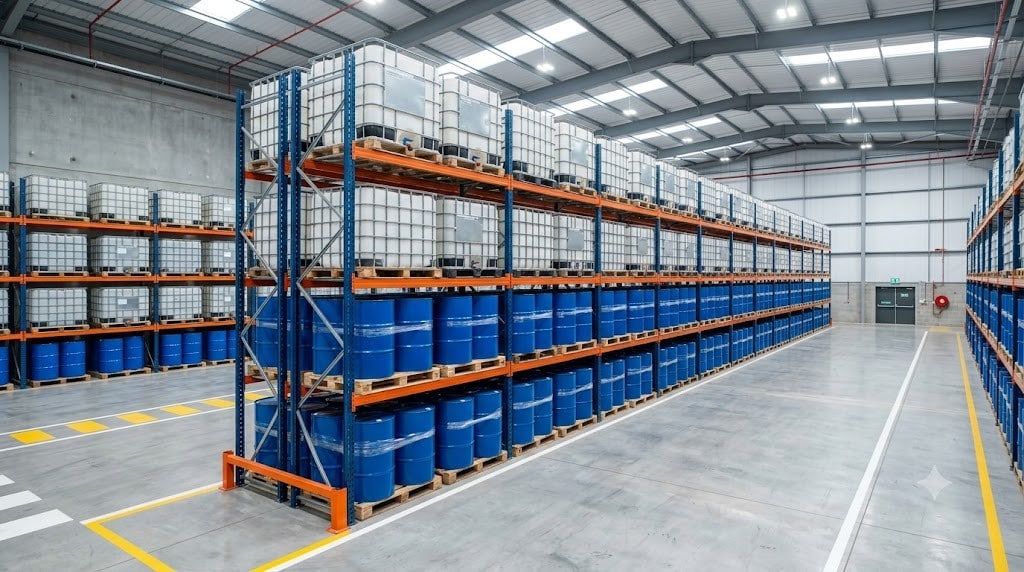
Buying in bulk is one of the simplest ways to protect your margins. Order more, pay less per litre, reorder less often. For any business that gets through chemicals week in, week out, volume buying just makes sense.
But bulk is a commitment. Bigger orders mean bigger deliveries, more storage and more responsibility once the pallet lands. Get the planning right and bulk supply keeps your operation running smoothly. Get it wrong and you’re left with stock you can’t store, use or shift. Here’s what trade buyers should weigh up before scaling an order.
The real cost saving of buying in volume
The headline benefit is price. Unit costs fall as pack sizes grow, and a drum or IBC almost always works out cheaper per litre than a stack of small containers.
The savings go further than the sticker price, though. Fewer orders mean less admin, fewer delivery charges and less time spent chasing dispatches. If you’re placing the same small order every fortnight, consolidating into a planned bulk buy usually pays for itself twice over.
Just be honest about your usage. Bulk only saves money if you actually get through it before shelf life or storage becomes a problem. Buying more than you can turn over isn’t a saving… it’s a write-off waiting to happen.
Minimum orders and pack sizes
Bulk chemicals come in standard formats, and knowing them helps you order the right amount for your space and your usage.
Typical trade pack sizes and how they load onto a pallet:
| Pack format | Units per pallet |
|---|---|
| 25kg bags | up to 50 |
| 25ltr containers | up to 32 |
| 200ltr drums | up to 4 |
| 1,000ltr IBC | 1 |
Match the format to how you use the product. Small containers are easier to handle and decant. Drums and IBCs cut the price further but need proper equipment to move and dispense. Pick the size your team can handle safely, not just the one with the best unit price.
Lead times: plan, don’t panic-buy
Bulk orders take longer to pick, pack and ship than a single container off the shelf. Most orders arrive within five to seven working days, so build that into your reordering rather than waiting until you’re nearly out.
The buyers who never run dry are the ones who track usage and reorder on a rhythm. Set a reorder point that leaves comfortable headroom, and you’ll never be caught paying over the odds for an emergency top-up.
Delivery and haulage of hazardous goods
Getting bulk chemicals to your door is a job in itself, and there are a few things worth knowing before the lorry arrives.
- Deliveries go to industrial premises only. Hauliers can’t deliver to residential addresses, even if that’s where your business is registered.
- Heavier consignments are charged per pallet, so consolidating orders keeps transport costs down.
- If you don’t have a forklift and need a tail-lift delivery, pallet weight is capped… typically 950kg net. Check this before ordering an IBC.
- New accounts are usually asked to complete a pre-delivery questionnaire covering opening hours, access and unloading equipment. It takes minutes and prevents failed deliveries.
A failed delivery is expensive and slow. Confirming access, opening hours and unloading kit up front is the single easiest way to avoid it. You can check the full detail on the delivery information page before you place a large order.
Storage: sort it before you scale
Bulk buying only works if you can house what arrives. Before you commit to volume, confirm you have suitable storage… proper containment, ventilation, and separation from incompatible substances.
Your COSHH assessments should cover the quantities you’re holding, not just the products. Storing 1,000 litres is a different risk to storing 25, and your risk assessment needs to reflect that. If your storage isn’t ready, order a sensible amount and scale up once it is.
Decanting and handling safely
Dispensing from a drum or IBC into working containers is routine, but it deserves care. Use the right pump or tap for the container, wear the protective equipment listed on the safety data sheet, and never decant into unlabelled bottles.
Every working container should carry the correct hazard labelling, and staff should be trained on the specific products they handle. Bulk changes the scale of the job, not the rules around it.
The bottom line
Bulk buying rewards businesses that plan. Right pack size, realistic lead times, storage that’s ready and a delivery sorted in advance… that’s how volume orders save money instead of causing headaches.
If you’re ordering regularly, work out your true usage, check your storage and talk to your supplier about the pack sizes that suit you best. Buy bulk properly and it becomes one of the most reliable savings in your operation.